Showing posts with label Book Reviews. Show all posts

Wednesday, July 6, 2016

Those Cultists Have Awfully Red Necks


25109947
               As a little girl, I was a regular patron of our local second-hand book store. This was despite the fact that the owners had Rush Limbaugh and the 700 club blasting from the radio whenever I went there and that 80% of the stacks were dedicated to moldering Harlequin Romances. I went there because paperbacks went for ¢.10, and hardbacks went for ¢.50, and that was the kind of money I could easily pull together from weeding or raking. And finally I went there because in the very back room, there were shelves and shelves dedicated to science and science fiction. This smelly, dusty, moldy little hole in the wall is where I stumbled upon the writings of H.P. Lovecraft.


                Twelve is pretty much the perfect age to stumble onto Lovecraft. At twelve, you’re young enough not to realize that pseudo-King James language is not a stylistic plus. You’re young enough to get grabbed right by the brain stem and into an endless sea of cosmic, impersonal horror. Lovecraft has informed my sense of what is pants-shittingly terrifying, so whenever I see a book that plays in this cold and uncaring sandbox, my interest is piqued. The fact that Lovecraft Country is by Matt Ruff, the author of Bad Monkey, a book about a bona-fide female anti-hero, only sweetened the pot.

                And then I turned over the book and read the summary. Atticus Turner, a WWII vet from Chicago, finds out his father has gone missing the summer of 1954. He and his Uncle George, publisher of The Safe Negro Travel Guide, have to find him because, you know, Cultists. (For those who haven’t read Lovecraft, Cultists feature heavily in the dude’s fiction.) The premise sold me, 100%.

                Structurally, this novel is a lot of fun. It’s more of a series of short stories tightly interwoven with a subtle dramatic arc than a standard novel with a central protagonist, which was kind of what the book summary led me to expect. I feel like it was a more challenging narrative to craft, but Matt Ruff really managed to keep all those balls in the air. He gave just enough information to forestall confusion while keeping the level of suspense painfully high. I am a pretty disciplined person, but I have to admit blowing past my scheduled bed time more than once during the reading of Lovecraft Country. Back in the day, I would have joyfully pulled an all-nighter to finish this book. 

                The stories each have a distinct theme, some more overtly Lovecraftian than others, but the overall feel of the novel was more of a nod to 50’s pulp horror. If you’ve done any listening to radio drama from the period, narratives like Horace and the Devil Doll will feel particularly nostalgic. Holy shit snacks, he even drops in a reference to Das Kriegsspiel, the granddaddy of Dungeons and Dragons. But like a writer worth his salt, Ruff makes these classic tropes work for the narrative in some really interesting ways, examining issues of race and class in both the segregated south and the supposedly more liberal north.

                For all of the strangeness of Lovecraft Country, with its cultists and its doors into hostile, alien realms, the shadow that looms deepest over the lives of Atticus Turner and his family is racism. The 1950’s tend to get held up as a “more wholesome time” in white American culture, but there’s a lot of overtly horrifying stuff that gets swept into the shadows. Lovecraft Country is at its most unsettling not when the opponents aren’t natural philosophers trying to unlock untold power, but when the Turners are making their way in white American spaces. The threat of violence is always in the air. Always. At one point, Atticus is pulled over by a cop in Indiana and learns that he’s in a Sundowner Town with just minutes to spare before sunset. 

                Sundown in Indiana was of many points where Ruff could have taken a side road. Lovecraft Country could have gotten a whole lot grimmer. A whole lot more claustrophobic. It’s not so much a criticism I’m leveling here. Writers have to make choices that will limit what a novel can do. Ruff’s choices were legitimate, they served to make Lovecraft Country my choice of this summer’s good read. But there’s a novel out there that hasn’t been written yet, one in an entirely different Lovecraft country, where all the real monsters wear human faces, one that I think deserves to be written. 


Monday, April 11, 2016

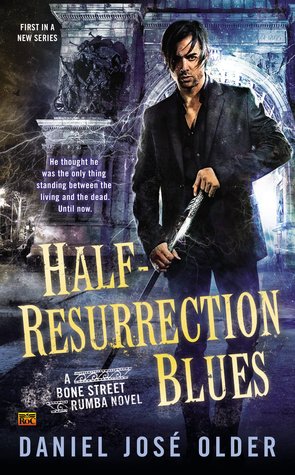
Done But Not Finished: A Review of Daniel Jose Older's Half-Resurrection Blues


 Half-Resurrection Blues (Bone Street Rumba, #1)

It’s been a long three weeks. I tried to plow through a nasty-as-fuck cold by working, reading more books, and keeping up a strict writing schedule, and there’s not much left in the engine (what a surprise). Also, I didn’t manage to get Naked Lunch read, and it’s hiding somewhere in my goddamn house like a total dick, so I can’t get caught up.
                On the happy front, I do have a new book review for your perusal. I’ve been informed by the production calendar that tomorrow is Fall Into a Good Book day, so maybe Half-Resurrection Blues by Daniel Jose Older could fit the bill.
If you’re a fan of gritty urban fantasy/private detective novels in the vein of Richard Kadrey’s Sandman Slim or Jim Butcher’s Dresden Files, you could definitely do worse. Older hits all of the satisfying notes, a good location, a witty narrator, lots of fun supernatural baddies, and manages to add a little something to keep the novel from falling down a singularity of tropeitude. Instead of some variety of magician, our narrator, Carlos Delacruz is a half-dead being employed by a shadow organization dedicated to keeping the delicate balance between life and death.
                Older draws on Santeria to build the world Carlos Delacruz inhabits, and I like it. In a lot of the books I’ve read, Santeria and Vudou receive a less than positive portrayal. It’s nice to see Santeros as part of the living spiritual community of Brooklyn, without all of the silly baggage that so often comes along for the ride. It just makes for a much more interesting read.
                Then there’s the question of style. Older’s language frequently crackles. It’s a bit uneven in spots, which is to be expected in a first novel, but he’s got a great ear for dialogue, and his descriptions of Brooklyn are frequently vivid enough to make me downright nostalgic. (I used to live in Crown Heights way back in the day. Let me tell you, it does my heart good to see places I used to haunt written up so well.)
                Half-Resurrection Blues is the beginning of a series. The most recent installment, Midnight Taxi Tango just came out this January. It is already on my massively out of control to-be-read list. (Incidentally, if I go missing, check my house for a large stack of books that smell a bit like dead people, because my TBR is just about ready to implode under its own weight.) I will let y’all know what I think when I get there.
                Laters. 

Monday, April 4, 2016

Grimdark Critters and Eldritch Horrors: Reads for a Sick and Sleepy Day


There are advantages to being sick, not the least of which are being able to eat ice cream as a meal and catch up with all the shit you’re usually too ashamed to watch on Netflix (Hello, Murder Maps). Illness is a great excuse to cozy up to some fine reading material, and boy did I ever take advantage last week. The key to a proper sick read is hedonism, and my two selections hit all of my guilty pleasure buttons.

The Builders


                                        The Builders by Daniel Polansky
Confession time. I was one of those little girls you’d see constantly toting around novels about animals. Like most, I started off with your softball stuff (think Black Beauty and Where the Red Fern Grows), but I quickly moved on to critter genre fiction. It didn’t matter what the package was Mrs. Frisby and the Rats of NIMH, Bunnicula, Redwall, Watership Down, I read it all. Critter fiction was my crack. I gleefully polished the bench in the principal’s office many a time just because I couldn’t stop reading some giant Brian Jaques novel while I should have been filling out yet another stupid goddamn worksheet. (No apologies. No regrets.)

Time passed and critter fiction faded into the fond, distant memories of childhood, probably because most of it, Watership Down excluded, failed to make the leap of sophistication into adulthood with me. Imagine my delight, then, when I picked up a slim novella promising grimdark critter fantasy.

I nearly squeed out loud. In the library. With strangers watching.

The Builders is at heart a simple revenge story. Years after a revolution that overthrew the legitimate monarch of the Gardens, the losing powers behind the fallen monarch gather together under the leadership of a mouse named the Captain one last time to get their own whatever the cost.

As the action progresses, it becomes clear that the Gardens are in a bad way. Order is kept, to be sure. But it is kept by totalitarian means. The prisons are empty because there is only one punishment for disobedience in any form: death. The architect, a skunk named Mephitic, is propping up the Younger, who is too dissolute to care about the actual running of the kingdom.

Ultimately the Captain and his crew are every bit as bloody, brutal and manipulative as their ascendant counterparts. I ended up seriously questioning whether the Gardens would have ended up being a damn bit better under the aegis of the Elder and the Captain. It’s a chess game played between psychopaths, and yet it’s so much fun to watch unfold.

As with all good revenge stories, The Builders ends in blood. It’s viscerally satisfying and brutal, and at only 219 pages, I left wanting more. Can I say right now that this is actually a good thing? Because it is. I’m more than a little sick of the current trend of five hundred plus page multi-volume monstrosities. Give me something with all the fat trimmed away any day of the week, something lean, vicious, and close to the bone. I don’t want to be sick of the company of my favorite characters. Polansky didn’t fail me here, for which fact I am deeply grateful.


Charlotte Markham and the House of Darkling


 Charlotte Markham and the House of Darkling by Michael Boccacino

Imagine Lovecraft’s Elder Gods decided to put on people skin suits and play at being human for a little while. Add a ghost story and a dollop of Victorian Gothic romance and you have the ingredients to Charlotte Markham and the House of Darkling. It’s the perfect book to read under mounds and mounds of blankets with a steaming hot cup of tea close at hand.

                Let’s start with the positives. The writing is just lavish. Boccacino really excels at fleshing out all the uncanny details that make up both the human world of Everton and the alien world of Darkling House and the Ending. He doesn’t spare any of the senses. And I do love an author who recognizes that horror can even be woven out of taste.
               
                In Charlotte Markham, the narrator of the novel, we have a strong woman who is driven by her growing feelings of love for her employer, the widower Mr. Henry Darrow, and her young wards, Paul and James. She’s driven by her feelings, but she is in no way dominated. Charlotte remains independent and decisive. She retains her agency in what proves to be a very deep, very dangerous chess game played between two opponents who think of humans, when they think of them at all, as vermin or playthings. Along feminist lines, I love this character to pieces.

                Then there’s the fusion of genres. For me, ghost story + Victorian Gothic Romance + Tentacled Abominations = Win. Pretty much always, actually. I would read the shit out of this novel a second time just to get a second hit of this sweet, sweet genre mashup.
               
                The one criticism I have is that the middle of the novel does tend to drag a bit. I feel that this is the one place where the author allows the plot to dictate Charlotte’s actions, and it ended up throwing me out of the story a little. But the doldrums didn’t last long, and the rest of the book had me riveted, so no big loss.
               
                I actually loved this book so much I went right to GoodReads to see if Boccacino’s published anything else. Sadly, it’s a no. I really hope he’s got something in the works, man, because I need another fix soon.